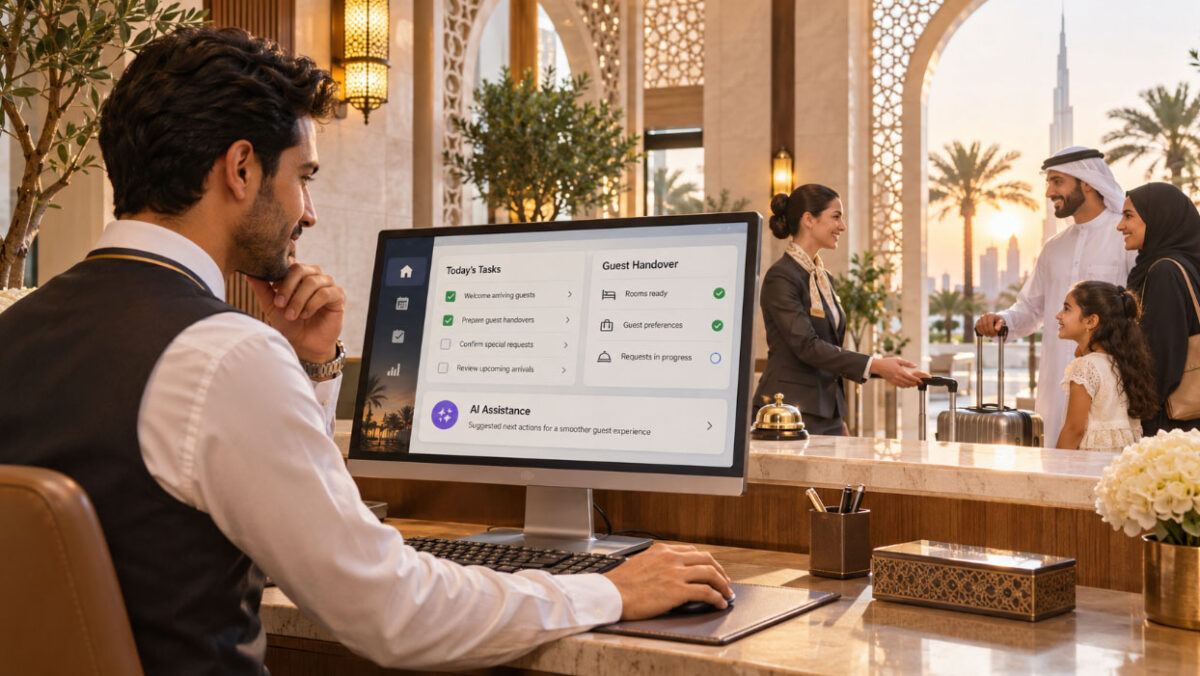
Hospitality runs on details. A guest expects a quick answer about a booking. A manager needs an updated staff schedule. An invoice must be checked, a supplier followed up, and tomorrow’s arrivals prepared. Each task matters, but together they can consume hours that your team would rather spend with guests.
That is where an AI-assisted virtual assistant can help. The person remains responsible for the work and the relationship. AI tools can help them organise information, prepare drafts, find patterns, and work through routine requests more efficiently. For a hotel, serviced apartment, holiday rental, or hospitality group, this creates a practical way to support busy teams without losing the human attention guests expect.
What Does “AI Assisted” Mean in Hospitality?
View an AI virtual assistant in hospitality as a supported way of working, not an unsupervised chatbot that makes all the decisions. An approved tool can be used by a trained assistant to prepare a response to a common inquiry, summarize a handover, or identify an incomplete record. Then the information is reviewed by an individual who deals with anything sensitive, unusual, or urgent.
This segregation is crucial. A guest asking about check-in time may need a quick, straightforward answer. We need someone who can understand the situation for a guest who has reported a problem with their room, work with the hotel team, and ensure the issue is resolved. An AI-assisted virtual assistant can support in both workflows, while keeping people in the communication loop where judgment is needed.
For companies in the UAE and the wider Middle East, the first step is to establish a clear definition of the work. This means defining which tasks can be done remotely, what systems the team has access to, when approvals are required, and how quickly issues should be escalated.
1. Keep Logistics and Guest Coordination Moving
Hospitality teams coordinate a constant flow of information. Airport transfers, supplier deliveries, maintenance visits, linen requests, and guest arrivals all depend on accurate updates.
Managed logistics support can help track requests, confirm schedules, update records, and follow up with the right person. An AI assisted virtual assistant might prepare a daily summary of pending deliveries or flag a booking that still needs a transfer confirmation. The assistant checks that information, contacts the relevant team, and records the outcome.
This can be especially helpful when a property manages several locations. Everyone needs to know what has been arranged, what is still pending, and who owns the next step.
2. Support HR, Payroll, and Accounts
Providing an exceptional guest experience is the responsibility of a team that has effectively managed its administrative requirements. During the busy season the employee records, attendance inputs, invoices, expense documentation and payment follow-ups can pile up in no time.
In the administration of the hospitality industry, an AI virtual assistant can help organize these records and prepare routine work for review. For example, an assistant can list items needing a manager’s decision, gather supplier invoices, point out missing entries and put together approved timesheets.
Only authorized people in your organization should approve finances, payroll, and other local compliance requirements. The value of managed support is that the groundwork is done consistently, allowing individuals to get to accurate information faster.
3. Give Managers Back Time for Guests and Staff
A general administrative assistant can help keep shared inboxes organized, update spreadsheets, create reports, maintain documents and follow up on open requests. When done well, these assignments hardly ever draw attention to themselves. Neglect of these brings repercussions throughout the property.
A virtual assistant with standard artificial intelligence can help prioritize routine requests and prepare a clear handover for the next shift. They can also track open issues and work that is completed. Managers get a better picture of the day without having to chase every update themselves.
Executive assistance is an entirely different need. A hotel owner or regional manager may need help organizing meetings, travel, correspondence, presentations, and action points across multiple properties. A reliable person is given to the leader for proper priorities to be kept through managed executive support.
4. Strengthen Your Digital Presence
A guest’s experience often begins before they even arrive. They might be looking for a property, comparing its website to its competitors’ and looking for information about the property’s location, amenities and booking options.
Digital marketing and SEO assistance can help hospitality businesses in the organization of content, the updating of listings, the maintenance of useful website pages and the maintenance of active social media channels. An AI-powered virtual assistant can help with content outlines and organizing performance data, while a marketing professional reviews the message, accuracy and brand voice before it goes live.
For a property in Dubai, Abu Dhabi or anywhere in the Middle East, it is important that the content is informative and answers real questions from guests. Describe the property’s amenities, its location, suitability for various demographics and the reservation process. Location keyword repetition on a page is less valuable than specific, accurate information.
5. Keep CRM, ERP, and Employee Systems Useful
A system is only good if its information is current. If updates are slow or sporadically recorded, guest preferences, corporate contacts, open inquiries, supplier records and employee details may be out of date.
An AI virtual assistant can help with the routine administration of employee management systems, ERP, and CRM in hospitality industry operations. That might mean updating records, looking for missing fields, generating reports, following up on assigned actions. The assistant follows the documented process and access rules with exceptions reviewed by a manager.
The result is more than a well-organized database. A reservations team can view the status of an inquiry. Operations can query the status of outstanding tasks. The leadership is able to make better informed decisions when the information is clearer.
How Managed Support Fits Into Your Team
The most effective arrangement is based on a small, well-defined scope. Choose a small number of tasks that are frequent, measurable, and suitable for remote support. Find out who is approving the work and document the steps and agree on the hours of coverage. “Try it out, see what works, then scale.”
When using a managed service, the assistant will be supervised, quality checked and backed up. Daily reporting can show you what was done, where your time went, and where your attention needs to go. This is especially true in the hospitality industry where a delayed handover can affect both guests and staff.
The most valuable thing an AI-assisted virtual assistant can do is allow a competent person to work with precision and react quickly, when technology allows it. This can lead to less administration, more organized operations and more time for those moments guests remember for hospitality businesses across the UAE and the Middle East.
Do you need assistance with your hospitality or property group? Let 24/7 Virtual Assistants do the tasks that take up your team’s time. We can help you create a managed support plan that fits your operations, systems and hours of business.