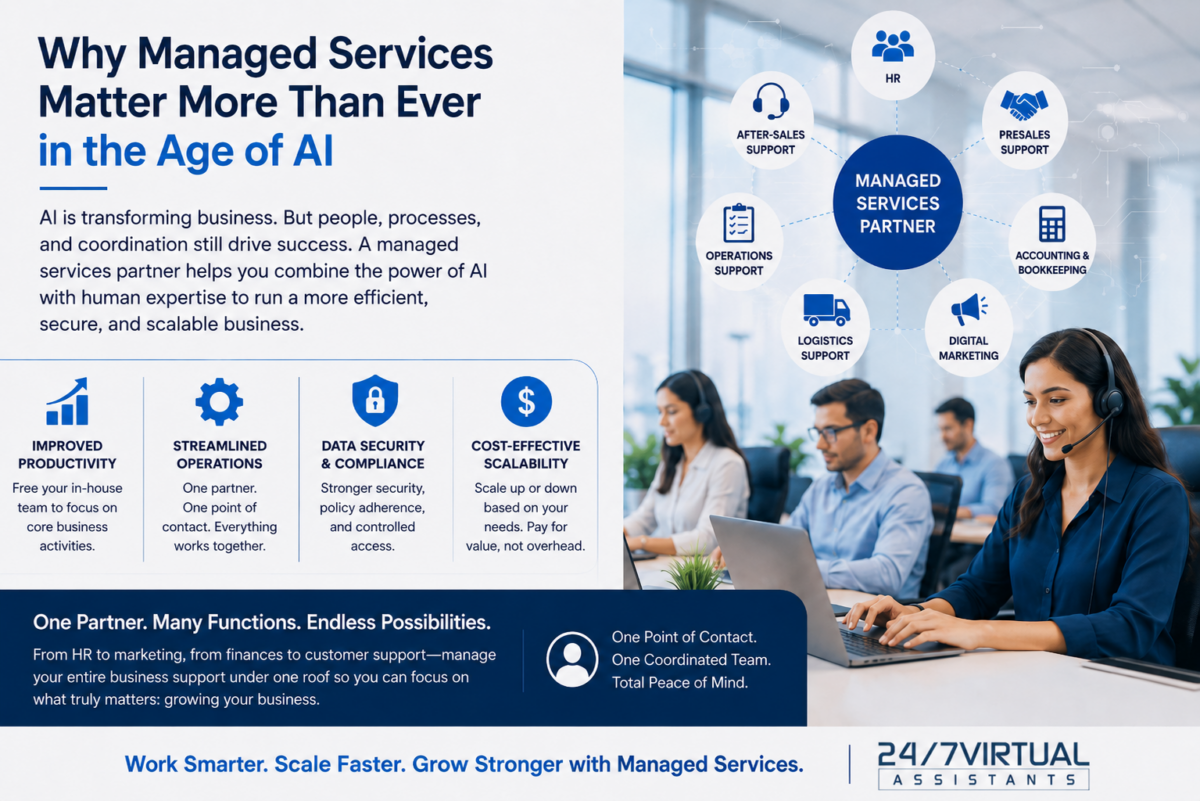
The Increasing Role of Managed Services in the Era of AI Artificial intelligence is transforming the way businesses operate. Things that required significant manual effort before can now be automated, information can be parsed at much faster rates and teams have tools that can change the game in terms of productivity. But AI has not eliminated the need for people, processes, oversight, or accountability.
The advent of AI in many ways has made effective operational management even more important.
Businesses now have to decide not just which processes to automate but who will oversee those systems, review their outputs, protect sensitive data, enforce corporate policies, liaise between departments, and ensure that the technology is genuinely improving the business rather than simply adding another layer of complexity.
This is where a managed services provider can be a key strategic partner.
AI Does Not Eliminate Operational Work AI is able to write emails, summarize documents, analyze spreadsheets, generate reports, interact with customers and automate repetitive tasks. But most companies still need people to manage workflows, review information, handle exceptions, communicate with customers and employees, update systems, coordinate departments, and make sure things are done right.
For many organizations, the challenge is not a lack of technology. It is a lack of coordinated operational capacity.
A company may have a great sales team, experienced leadership and strong products or services, but valuable employees can easily lose hours each week on administrative duties.
They could be calling back customers, entering data in the CRM, generating reports, scheduling meetings, verifying invoices, maintaining employee documentation, liaising with vendors or answering routine questions.
These activities are necessary, but they may not be the highest-value use of an experienced employee’s time.
A managed services model allows companies to move many of these support functions to a dedicated external team while allowing their internal employees to concentrate on activities that directly contribute to growth.
One Managed Services Partner, Not Several Disconnected Providers Traditionally, outsourcing meant hiring different freelancers, agencies or specialists for different functions.
One person might manage bookkeeping. Digital marketing may be handled by another company. A freelancer can provide administrative support. Another consultant could manage HR processes.
Although this model can work, it often creates another management challenge.
Someone inside the company still needs to coordinate all those providers.
Meetings have to be scheduled. Information needs to be transferred between teams. Providers may have different systems and processes. Responsibilities can overlap, and important tasks can slip through the cracks because no one is clearly responsible for them.
A full managed services provider takes a different approach.
Rather than overseeing five or six different outsourcing relationships, a company can partner with one organization providing multiple support services.
These may include:
- Human resources administration
- Executive and administrative assistance
- Presales support
- Customer service and after-sales support
- Accounting and bookkeeping
- CRM management and data entry
- Operations support
- Logistics coordination
- Reporting and MIS
- Digital marketing
- Lead generation and follow-ups
- Appointment scheduling and calendar management
- Document management and business administration
The result is a more integrated operational structure.
Power of Internal Team Coordination in the Outsourced Team One of the biggest benefits of working with one managed services company is coordination.
Imagine a business where a customer service assistant discovers a billing error. If the bookkeeping is handled by someone completely separate, the customer service representative may need to contact the business owner, who then contacts the bookkeeper, who then sends information back to customer service.
Then the business owner really is the communication bridge.
With an integrated managed services team, the customer service representative and accounting support team may already work within the same organization, follow common procedures, and operate under coordinated supervision.
The issue can therefore move internally between the appropriate people without requiring the business owner to manage every interaction.
The same principle can apply across HR, operations, sales support, administration, logistics, and reporting.
Instead of multiple outsourced individuals operating independently, the company gains an external operational team that can collaborate internally.
Less unnecessary communication, less calibration meetings, less duplicated instructions, less broken workflows.
Boosting the Productivity of the In-House Team Perhaps the biggest benefit of managed services is not just in savings on operating costs.
It is making the existing employees of the company more productive.
If you have highly skilled employees who spend much of their day doing repetitive administrative work, your business isn’t leveraging their capabilities.
Ideally, sales professionals should spend more time selling.
“Managers need to spend more time on managing people, strategy and performance.”
Business owners should be spending more time on things like building partnerships, improving products, entering new markets and making strategic decisions.
The day-to-day support activities are handed over to a managed services provider and this allows in-house staff to spend more time on the work that really requires their knowledge and experience.
This creates operational leverage.
Rather than continuously increasing internal headcount as the business grows, companies can build a support infrastructure around their existing team.
Managed Services and the Responsible Use of AI
The strongest managed services providers in the coming years will not simply provide people.
They will combine people, processes, technology, and AI.
In the case of outsourced teams, standard artificial intelligence can help them work faster. It can be used for research, reporting, writing documents, data processing, customer service, process automation and data management.
Yet supervision by humans is still required.
Information of a confidential nature must be safeguarded. AI information is to be checked. Systems access should be controlled. Employees have to know what information they can put into external artificial intelligence (AI) systems and what they cannot, and are responsible for following company policies.
A managed services provider with structure can put processes in place for these things.
For example, instead of granting all employees unrestricted access, access may be granted based on the job responsibilities of the user. Standard operating procedure can dictate how to handle information. Supervisors can check for compliance; quality control processes can find mistakes or exceptions.
The result is an AI-powered productivity mixed with oversight by humans, which allows businesses to enjoy the benefits of technology without losing accountability.
Data Security & Process Compliance Operational efficiency and data security need to be simultaneously achievable for increasingly digital businesses.
Sensitive information can be found in customer records, financial information, employee documents, business strategies, passwords, contracts and internal reports.If you have a lot of independent contractors doing work for you through outsourcing, access management can get messy.d. . Governance can be simpler in an integrated managed services environment as permissions, processes, confidentiality requirements and supervision can be coordinated through a central provider.
But organizations should still be implementing the right security controls such as role-based access, NDAs, password policies, access reviews and documented procedures.
The objective is not simply outsourcing work.
It is building a controlled extension of the company’s operations.
Managed Services Are Not Just for Large Companies
There is sometimes a misconception that managed services are only relevant to larger companies.
In reality, small businesses and even one-person companies can potentially gain the greatest benefit.
Consider an entrepreneur managing a growing business alone.
The owner may be responsible for sales, customer communication, bookkeeping coordination, social media, appointments, follow-ups, reports, vendor communication, and administrative work.
It becomes almost impossible to focus on growth.
Instead of hiring separate employees for every function, the entrepreneur could work with a managed services partner such as 24/7 virtual assistants and build a support team around the business.
One assistant may manage administration and scheduling. Another specialist may help with bookkeeping. Customer service support can handle routine inquiries, marketing support can handle content and campaigns.
It’s as if the business owner has access to a much larger operations team, without having to establish an entire internal department.
Growing Without Building a Huge Internal Infrastructure Managed services also have the advantage of scalability.
Business requirements are seldom static.
In busy periods companies may require extra customer service support, more accounting assistance at month end, more administrative capacity during a project and more marketing support during a product launch.
Building in-house teams for every peak demand can be costly.
Managed services give organizations the ability to ramp support up or down according to operational needs.
This means a more flexible cost structure and can allow growing businesses to grow faster.
The Future Is AI-Enabled, Human-Managed Operations
AI will continue to automate tasks, but successful businesses will still need coordination, judgment, accountability, communication, and structured processes.
The question for many businesses is therefore changing.
Instead of asking, “What jobs can AI replace?” a more useful question may be:
How can we combine AI, automation, skilled support teams, and our internal employees to operate more efficiently?
A capable managed services provider can become part of that answer.
By consolidating administrative support, HR, accounting, customer service, sales support, operations, logistics, marketing, and other business functions under one coordinated provider, companies can create a streamlined support infrastructure around their core team.
For organizations such as 24/7 Virtual Assistants, the opportunity is no longer simply providing virtual assistants.
It is helping businesses build an outsourced operational ecosystem where people, technology, processes, supervision, and AI work together.
In the AI era, that kind of operational leverage may become one of the most important competitive advantages a growing business can have.